2 Burner Gas BBQ UK: How Many People Can It Really Feed?
A practical UK guide to two-burner gas BBQ capacity: calculate usable grill space, plan two-zone cooking, choose the right regulator and host four to six people safely.
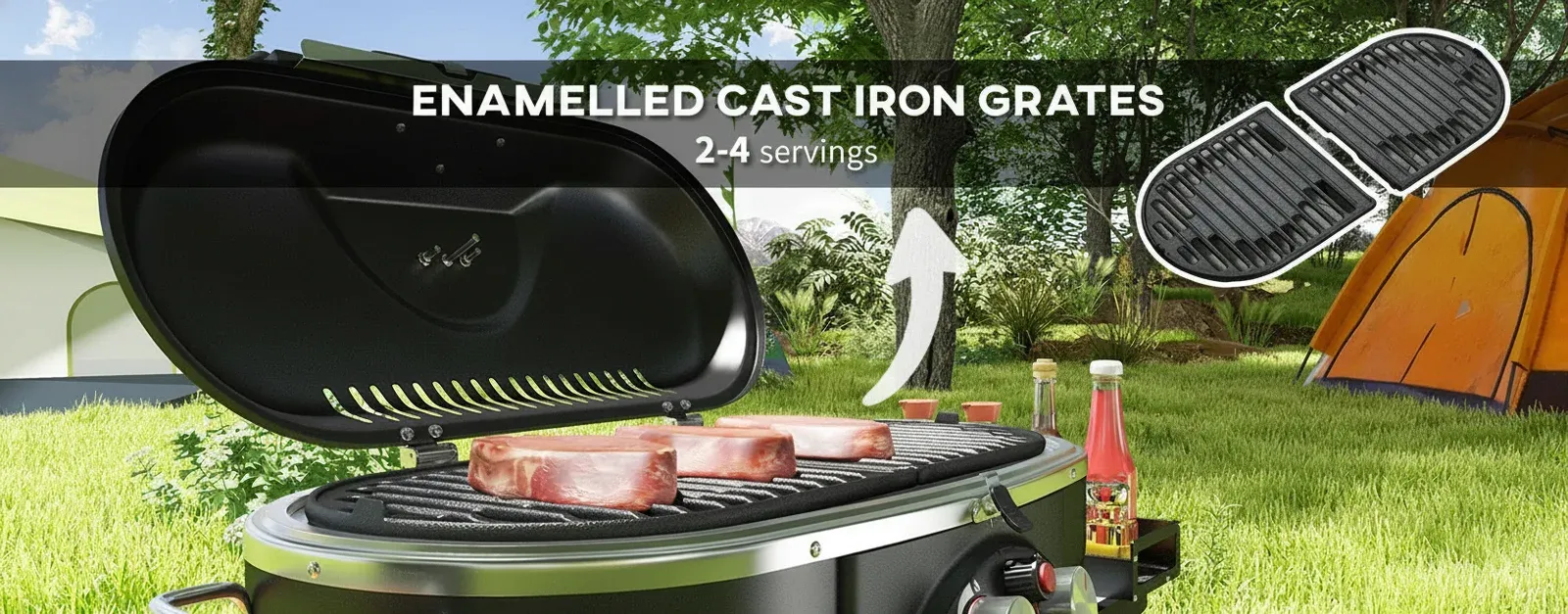
A two-burner gas BBQ is usually the sweet spot for a small UK garden: compact enough to store, but capable of running a hot direct zone and a gentler finishing zone at the same time. The honest capacity is four people in one relaxed cook, or up to six when you plan two waves. Burner count alone cannot promise that result; usable grate area, menu and safe working space decide it.
This guide shows you how to judge capacity before buying and how to host without turning every centimetre of the grate into a traffic jam.
The answer in one table
| Group | Realistic two-burner plan | When to choose larger |
|---|---|---|
| 2 people | One mixed load with room to move food | Rarely necessary |
| 4 people | Main items plus a cooler holding/vegetable zone | If you cook several bulky cuts together |
| 6 people | Two planned waves; serve sides between them | If everyone must receive a full mixed plate at once |
| 8+ people | Continuous batches and careful holding | A larger three/four-burner cart is usually easier |
The numbers assume a normal mixed menu, not six identical burgers. Chicken pieces, corn, skewers and halloumi occupy different shapes and cooking times.
Measure the cooking area, not the lid badge
Ask for the usable grate width and depth. Multiply them for a rough area, then subtract space lost to edges, warming racks or sections that cannot be controlled independently. Lay paper templates of your planned food on a table if you need a reality check.
A useful host’s test is whether the grate can hold:
- the main item for half the guests;
- one vegetable or meat-free section with separate utensils;
- an open strip for turning and moving food away from flare-ups.
If every square centimetre is occupied, you do not have control; you have a queue on a hot surface.
Why two independent burners matter
Two burners are valuable because they can do different jobs. Preheat as the manual directs, then keep one side hotter for colour and one side lower, or off where permitted, for gentler cooking. This gives you somewhere to move food when the outside is ready before the centre.
Use the zones as a workflow:
- Hot zone: initial searing and fast-cooking items.
- Gentle zone: finishing thicker items with the lid down where the appliance supports it.
- Clean section: meat-free food with separate utensils and no raw-meat contact.
- Off-grill holding: a clean warm serving dish; do not leave cooked food sitting indefinitely on the barbecue.
Our broader gas barbecue UK buying guide covers a cold setup rehearsal before the first cook.
A six-person menu that fits
The easiest plan is two waves rather than six individual orders.
Wave one
- items that need the longest thorough cook;
- vegetables that can be served warm or at room temperature;
- bread or side dishes prepared away from the raw-food area.
Wave two
- burgers, halloumi or other quick items;
- a final batch for people who arrived late;
- reheating only when the food-safety method supports it.
Keep raw and cooked utensils separate. The Food Standards Agency’s barbecue guidance stresses safe preparation and thorough cooking; colour on the outside is not proof that meat is safe in the centre.
Fit for a small UK garden
Storage often matters more than theoretical output. Before buying, measure the route from cooking position to shed or storage area, including gates and steps. Confirm the barbecue can be moved only when cool and disconnected as directed.
A folding model can make sense when the hinges lock positively, the gas connection is protected and the folded dimensions fit the actual storage space. See our folding BBQ guide for that decision.
Place the operating barbecue outdoors on a stable level surface, well away from sheds, fences, trees and anything combustible. Never use it in a home, garage, tent, awning or caravan. Keep children, pets and games away from the cooking area.
Gas, regulator and hose: check before the party
Do not assume that “patio gas” or a familiar bottle means the connector and pressure are correct. The appliance data plate and manual must identify the fuel category and regulator requirements. Use the specified arrangement, inspect the hose and joints, and change cylinders outdoors with controls off.
If you suspect a leak, turn off the cylinder. UK fire-safety guidance describes applying soapy water around joints and watching for bubbles; never test with a flame. Do not use the appliance until an uncertain or damaged connection is resolved.
Our camping gas BBQ guide separates bottle and regulator checks from cooking capacity.
What to inspect on a two-burner BBQ
Burner control
The controls should be clearly labelled and usable without reaching across heat. Each burner should light and respond according to the manual. Persistent uneven flames, delayed ignition or a gas smell is a stop signal, not a cooking quirk.
Grease management
Look for a removable tray that can be reached without dismantling the hot side of the appliance. Accumulated grease raises flare-up risk and turns routine cleaning into avoidance.
Lid and wind behaviour
A lid helps retain heat for finishing, but it does not create unlimited capacity. Follow the maker’s lighting rules, especially whether the lid must be open during ignition. Wind can disrupt flames and carry heat towards fences or guests; reposition only when the barbecue is off and cool.
Grate and replacement parts
Check how the grate is cleaned, whether it is stable, and whether burners, igniters, hoses and regulators can be replaced. A compact barbecue is better value when ordinary wear parts remain obtainable.
A pre-hosting checklist
- Assemble and leak-check in daylight before guests arrive.
- Confirm fuel and regulator from the data plate/manual.
- Put the barbecue on stable level ground outdoors.
- Keep a bucket of water, sand or a garden hose nearby for emergencies.
- Prepare separate raw, cooked and meat-free utensils.
- Decide the two cooking waves in advance.
- Keep the route around the barbecue clear.
- After cooking, turn off the gas supply first and then the barbecue control as official guidance advises.
- Let the appliance cool fully outdoors before moving or cleaning it.
Is the BBQTour two-burner a fit?
The current Tower portable two-burner product page is the place to verify today’s included parts, dimensions, fuel requirements, price and availability. Judge it against your measured storage space and six-person menu rather than a generic “serves” badge.
Do not buy it if the regulator arrangement is unclear, your only proposed location is enclosed or on a prohibited balcony, or you regularly need eight complete meals at once.
Frequently asked questions
Is a two-burner gas BBQ enough for six people?
Yes, when you cook in two planned waves and serve sides alongside. If six full mixed meals must leave the grate together, choose a larger cooking area.
Can I cook meat and vegetarian food at the same time?
Only with a genuinely separate clean section and utensils, protected from raw-meat juices. Ask guests about their requirements rather than assuming separation is sufficient for everyone.
Can I use a gas BBQ in a garage with the door open?
No. Use it outdoors, away from structures and combustible material. Carbon monoxide and fire risk make enclosed or partly enclosed use unsafe.
Which gas bottle do I need?
Use the fuel, pressure, regulator and hose specified on the appliance data plate and in its manual. The burner count does not answer this.
Bottom line
A two-burner gas BBQ is not a small four-burner. Its advantage is control: one hot zone, one gentler zone, a compact footprint and predictable batches. For four people it is easy; for six it works with a plan; for eight or more a larger grate usually makes hosting calmer and safer.